

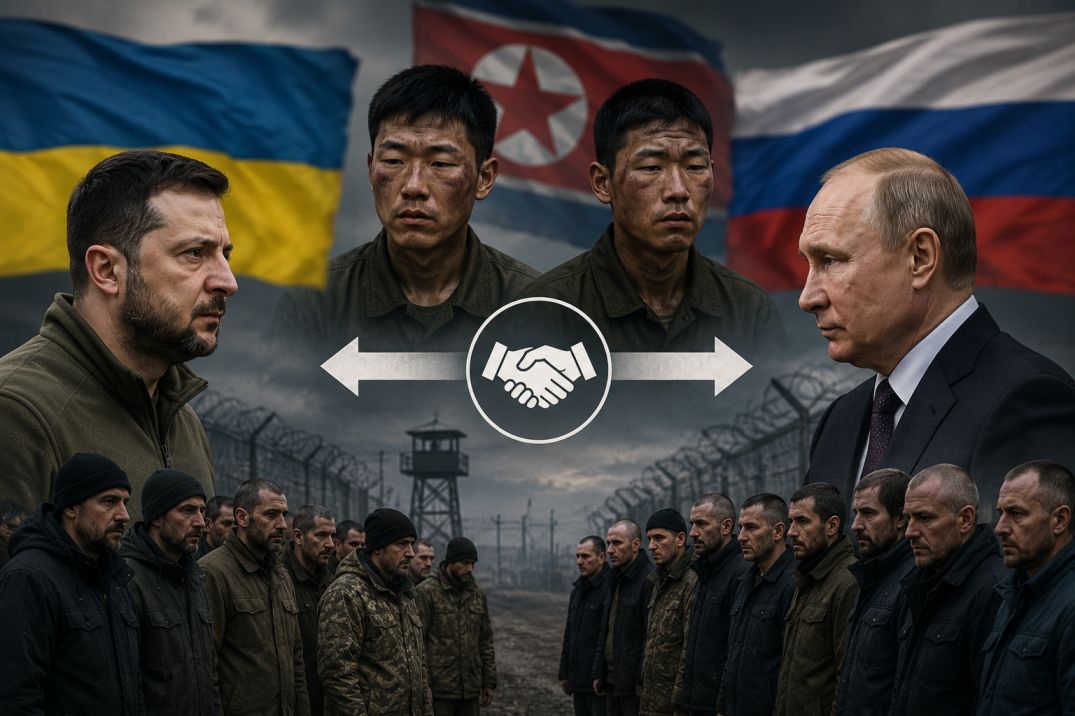
Russia has allegedly proposed a prisoner exchange involving thousands of Ukrainian soldiers in return for two North Korean soldiers captured by Ukraine. This report comes amidst Ukrainian Foreign Minister Andrii Sybiha’s visit to South Korea, where he discussed the situation with South Korean Foreign Minister Cho Hyun. The two North Korean soldiers, who were captured in Russia’s Kursk region in January 2025, have expressed a desire to settle in South Korea, complicating the situation further. Despite these developments, some diplomatic sources remain skeptical about the likelihood of Moscow making an offer of this magnitude.
The issue emerged during Sybiha’s meetings in Seoul, particularly during his participation in discussions at the Asan Institute for Policy Studies. According to those informed about the private discussions, Sybiha indicated that Russia had proposed returning the captured North Korean soldiers to Pyongyang in exchange for the release of numerous Ukrainians under Russian detention. These remarks, however, were intended to highlight the complex political decisions facing Ukraine rather than to mark the start of formal negotiations.
This proposal underscores the difficult balancing act Ukraine faces between addressing humanitarian concerns and securing the freedom of its citizens. South Korea has reiterated its willingness to accept the North Korean soldiers should they choose to relocate willingly, as they are considered South Korean citizens under the South Korean Constitution. Ukrainian authorities have also made it clear that they will not forcibly repatriate the prisoners against their will, although a final decision on the matter has yet to be announced.
In addition to the prisoner exchange discussions, talks between Seoul and Kyiv have broadened to explore South Korea’s potential involvement in Ukraine’s postwar reconstruction efforts. Ukraine is interested in South Korea’s assistance in rebuilding critical infrastructure, energy facilities, and other essential sectors following the conflict. However, South Korea has emphasized that humanitarian issues concerning the prisoners of war are distinct from broader cooperation on reconstruction or other forms of aid.
The fate of the two North Korean soldiers remains unresolved as both Ukraine and South Korea navigate consultations guided by international law and humanitarian principles. As diplomatic discussions progress, the case has evolved into a sensitive issue, intertwining humanitarian responsibilities, prisoner exchanges, and regional security considerations. The outcome will likely have implications for both humanitarian obligations and the broader geopolitical landscape.
