

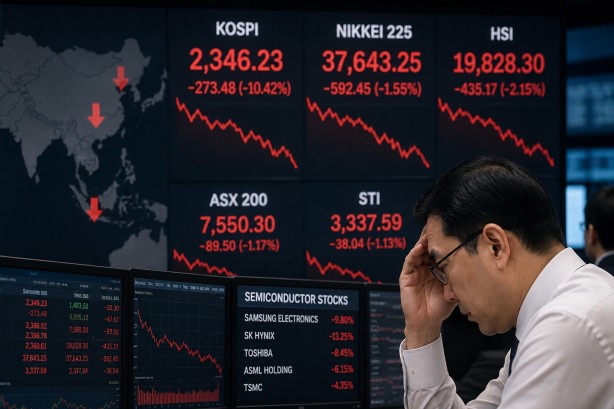
Asian stock markets experienced a downturn on Tuesday, predominantly driven by a significant sell-off in South Korea. The Kospi index in South Korea nosedived over 10%, largely due to substantial declines in semiconductor stocks. Notably, shares of Samsung Electronics and SK Hynix each plummeted around 12%, as investors became increasingly wary about the rising competition from Chinese AI startups and chip manufacturers, which could potentially hinder the expansion of the global artificial intelligence sector.
Other major Asian markets also saw declines, with Japan’s Nikkei, Taiwan’s Taiex, Hong Kong’s Hang Seng, and China’s Shanghai Composite all closing in the red. These losses underscore the broader regional apprehension regarding the competitive landscape in technology and its implications on market stability. In contrast, Australia’s S&P/ASX 200 stood out by recording gains, bucking the trend observed in other leading indices.
The concern over semiconductor stocks in South Korea highlights the growing anxiety about the global tech industry’s future, particularly in the face of emerging Chinese competitors. These developments are prompting investors to reassess the potential growth trajectory of companies heavily invested in AI technology, which is seen as a pivotal component of future technological advancements.
In the commodities market, oil prices experienced a decline as tensions between the United States and Iran appeared to ease. This de-escalation has fostered optimism about the possibility of renewed diplomatic negotiations, simultaneously alleviating worries about disruptions to global energy supplies. The prospect of reduced geopolitical tensions is contributing to a more stable outlook for the oil market, at least in the short term.
