

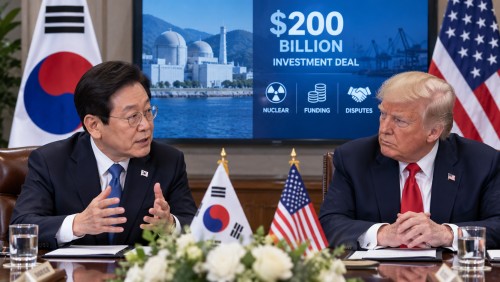
South Korea and the United States are grappling with unresolved issues regarding nuclear projects and financial commitments tied to Seoul’s anticipated $200 billion investment in the U.S., casting uncertainty over a potential agreement. The negotiations, which have seen complications surrounding nuclear reactor designs and funding timelines, remain ongoing without definitive resolutions.
Nuclear power has emerged as a central point of contention, with discussions revolving around the construction of eight reactors on U.S. soil. The proposed designs include six reactors based on Westinghouse’s AP1000 and two using South Korea’s APR1400 technology. South Korea intends to channel approximately $120 billion of its investment into these nuclear projects. However, opposition from U.S. officials and Westinghouse against the inclusion of the APR1400 design has stalled progress.
Adding to the complexity, South Korea is seeking a 15% to 20% stake in Westinghouse, complete with voting rights and a position on the board, whereas Westinghouse is reportedly pushing to cap Seoul’s stake at below 10%. Further complicating matters is South Korea’s potential involvement in processing spent nuclear fuel in the U.S. and a proposed liquefied natural gas project in Alaska, which carries concerns over construction costs and long-term returns.
The timeline for financial contributions is another sticking point. While the U.S. has requested more than $9 billion from South Korea by year-end, Seoul initially planned to begin with a smaller sum in 2026, gradually increasing investments starting in 2027. Disagreements also persist over how to handle investment returns, with South Korea advocating for profits from successful projects to mitigate losses from less successful ones, a notion the U.S. opposes in favor of separate accounting for each project.
Despite these significant differences, both countries continue to negotiate the investment package’s finer details. South Korea’s Industry Ministry has emphasized that decisions on the final projects and their funding structures remain undecided, leaving room for further discussions and potential resolutions.
