

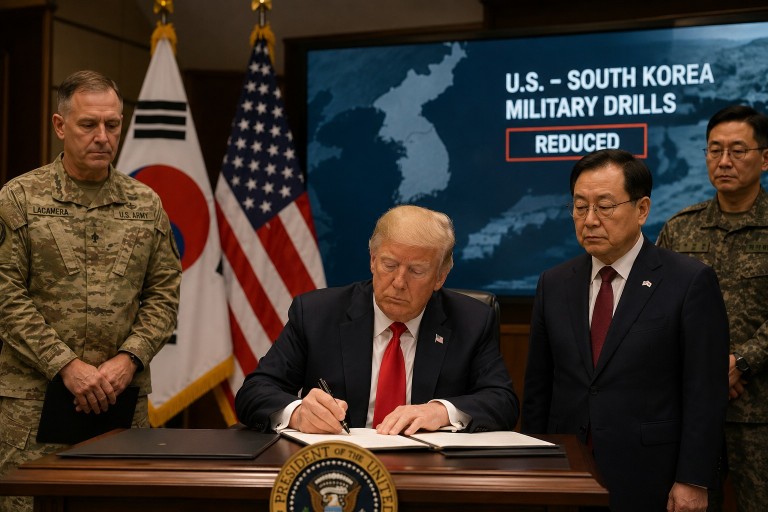
President Donald Trump has initiated a significant reduction in the joint military exercises between the United States and South Korea, citing high costs and the desire to maintain a positive rapport with North Korean leader Kim Jong-un. The scheduled Ulchi Freedom Shield exercises were set to involve approximately 18,000 South Korean troops, along with U.S. forces and several other United Nations Command member states, commencing Monday and running through August 27. Although the drills will proceed as planned, Trump’s directive to Defense Secretary Pete Hegseth aims to notably decrease U.S. participation, drawing a mixed response from Seoul.
The decision arrives amidst growing concerns from U.S. and South Korean military officials about North Korea’s increasing battlefield experience, gained through its collaboration with Russia in the ongoing Ukraine conflict. North Korea has reportedly dispatched over 14,000 troops to support Russian forces and supplied artillery ammunition and ballistic missiles. This involvement is providing North Korean forces with exposure to contemporary warfare technologies, such as drones, GPS disruption, cyber operations, and advanced missile systems, potentially enhancing Pyongyang’s military capabilities upon their return.
In response to these evolving threats, U.S. military officials have adjusted the exercises, underscoring the necessity of these drills for maintaining readiness. They caution that the skills North Korean troops acquire in Ukraine could bolster North Korea’s military strength, raising alarm regarding regional security and the robustness of the U.S.-South Korea alliance. Trump’s history of scaling back major military exercises while engaging in diplomacy with Kim Jong-un adds another layer of complexity to the current situation.
Concerns have been voiced by South Korean experts who argue that reducing the joint exercises could undermine military preparedness and deterrence efforts, without yielding significant diplomatic advantages. Historically, North Korea has demanded a complete halt to such drills, labeling them as preparations for offensive warfare, and has threatened to escalate military activities in response. Notably, Pyongyang has already conducted ballistic missile tests in anticipation of the exercises.
Despite the potential diplomatic intentions behind Trump’s decision, South Korean officials emphasize the critical role of the joint military exercises in defending against North Korea’s increasingly capable forces. The future of the U.S.-South Korea security partnership hangs in the balance as both nations navigate the complex interplay between diplomatic engagement and military preparedness in the face of North Korea’s evolving threats.
